Showing posts with label Business Intelligence. Show all posts

Sunday, September 15, 2013

3 Key Takeaways from the 2013 i2 User Conference


This week, two of our analysts attended the 2013 i2 User Conference. We were able to network with and attend sessions led by individuals working in the law enforcement, intelligence, and financial communities in the United States and Canada. Although many of us work in seemingly different fields, many of us concluded that we were ultimately doing similar tasks and face similar issues. At the end of the conference, there were three major takeaways that can relate to any investigator or analyst, regardless of their industry or what tools they use.

Data Silos are the Past and Fusion Centers are the Future

The key issue discussed by almost every speaker and attendee was the difficulty we all face gaining access to and sharing information across departments and agencies. One problem almost every agency reported was having too many data silos housing their information. Multiple storage locations fragment the information in such a way that individuals can be consumed by looking through disparate sources for data, even in their own agency. It also impedes the flow of information between both coworkers and partner organizations. This problem was stressed by multiple law enforcement agencies during their presentations, especially in the case of the Boston Marathon Bombing.

Now, these agencies are working together to tear down the walls between organizations to adapt a fusion center model. The Tucson Police Department, Massachusetts State Police, and the Miami-Dade Police Department have all reported they are working on initiatives to bring together interagency data sources to assist with investigations and prevent agencies from stepping on one another’s toes. Similar collaborations are happening in the financial industry in Canada through the Canadian Banker’s Association. It is becoming imperative that agencies share information to be effective in their day-to-day intelligence and investigative endeavors.

Nothing Exists in a Bubble

Multiple speakers discussed the need for us all as investigators, analysts, researchers, and intelligence operatives to understand the world around us. It is extremely important to understand the world around you from culture to events to societal changes. Dr. Steve Chan really drove the point home that nothing we examine exists in a vacuum, and in order to fully understand the issue at hand, we have to educate ourselves about the larger picture as a whole, including historical and present context. To be truly effective, we must keep up with items such as current events, changes in society, trends, new technology, and pop culture. In addition, we also need to ensure we are constantly engaging coworkers and individuals from other agencies to share information.

Social Media is Paramount

It was evident from the start of the i2 Conference that social media was going to take the main stage. Most of the sessions at this conference touched on the importance of social media, and the sessions specifically regarding social media were standing room only. Social media is now becoming widely regarded for its ability to give analysts and investigators new leads in cases when all internal data and public records information have been exhausted. It also is a fantastic resource for network building because we can identify underlying connections that may have been missed through other investigative means. However, there are still some issues with data normalization and legal admission of social media evidence. People are now looking for new ways to better extract, analyze, authenticate, and fuse data from the social media goldmine. As researchers, it is imperative that we stay abreast of all of the changes in the social media landscape.

Conclusion

For us, the i2 User Conference was a success. We were able to learn from individuals in related industries about the challenges they face and how they are working to conquer them. One of the only ways we can learn is to work together to create new, innovative solutions to the issues that plague our organizations.

Wednesday, September 4, 2013

Social Media Platforms 101: LinkedIn

One of the first things people ask during PRISM training sessions is “how does that social media site help me accomplish [my goal]?” Often, we spend more time during our training sessions covering the usefulness of social media sites rather than talking about how to use the tool itself. We decided it was time to launch a little series called Social Media Platforms 101. It is designed to help our readers understand the basic construct of the platform itself, the information you can gather from different social media platforms, and how that information can be used.

As we’ve been focusing on employment issues recently, we thought it was pertinent to begin with LinkedIn.

What is LinkedIn?

LinkedIn is a professional networking site. It allows users to create profiles that showcase their current and past work experience, educational background, and skills that they may have. Users can also connect with individuals and join groups based upon their industries, interests, and affiliations. This allows LinkedIn members to network with one another to find new business and job opportunities. Currently, the main users of LinkedIn are professionals looking for new job opportunities, employers and recruiters looking to hire new talent, and managers and executives searching for new business ventures and partners.

One important thing to note about LinkedIn is that privacy settings can be very stringent. While many people leave their profiles open to attract more traffic, it can be difficult to glean information from a profile without being connected to the individual. However, you can still often access information by being connected to a user who is connected to the individual of interest.

What Can You Learn From LinkedIn?

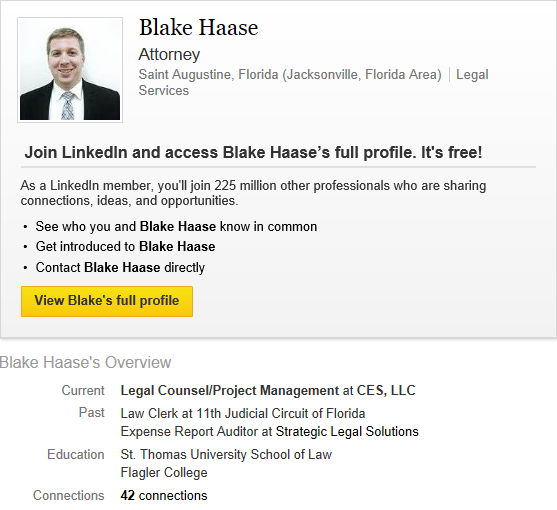
In order to demonstrate how you can pull information off of LinkedIn, our Legal Counsel, Blake Haase, volunteered his LinkedIn profile.


When you look at Mr. Haase’s page, you can see a brief overview of his work experience and the number of connections he has made on LinkedIn. If you scroll down a little further you will notice he has listed out some of his job duties and a few projects he has worked on during his professional career. In addition, you will find information about the degrees he earned, his listed skills, and the groups he belongs to. Cumulatively, this page paints a basic profile of Mr. Haase’s job experience and qualifications.


In addition, if you are logged in to an account and are connected to the individual, you can access a connection chart that will show your commonalities with the person of interest.
 
How Can You Use Information Found on LinkedIn?
 
The major use of LinkedIn is obviously employment related. Whether you are an employer vetting out applicants or a firm conducting background checks on behalf of another organization, LinkedIn’s strongest usage is in constructing educational and professional profiles. This information can be used to corroborate or find inconsistencies in information provided by prospective employees on resumes and applications, and it can provide additional information about the individual’s past history that was omitted from their resume. However, it can also be used for basic investigative purposes: constructing timelines, building connections, learning interests and skills, and gaining more general insight into your person of interest.
 
Conclusion
 
Not all social media sites are created equally. Each one has its own unique set of data and serves a different set of purposes. As technology evolves, the usage of and the information found on each site will evolve along with it. It is up to us as investigators and analysts to keep abreast of these trends and provide the best services possible.

Wednesday, July 31, 2013

Tips & Tricks: Three Easy Ways to Maximize Your Training Experience


Over the past few months, the team has been taking advantage of conferences happening around the state. At the center of all of these conferences were knowledgeable experts speaking and providing training. However, upon examining the materials our team brought back, we found the training was not always up-to-date and usually did not cover new, relevant practices or sources of information. Everything changes quickly on the Internet, whether it is changes in privacy law, new best practices, or the popularity of social media platforms. As investigators and researchers, it is important we budget our time and ensure we are spending our funds wisely to keep abreast of these changes.

Here are some quick easy tips on how to make the most of your training experience.

Vet the Trainer

Beware of self-proclaimed experts. Many individuals actually work in areas tangentially related to the subject of the training. Learning the perspective of the trainer can greatly inform you about what to expect to learn from a training session. In order to ensure the trainer has working knowledge of the subject, research their biographies appearing on websites, news sources, and social media profiles. You can also use information present on conference websites and in related training files (see below) to see if trainers cover material from an angle that matches your needs. Additionally, these sources can give you an idea of when the trainer worked in this field, whether or not they are using up-to-date information and techniques, and if they routinely update materials or simply recycle the same information.

Get Free Materials Using Internet Searches

Many trainers and conferences post documents and videos online which are readily available for use. All you have to do is leverage Internet-based searches to your advantage. Good places to start looking for information are on websites of companies and individuals which provide training, conference websites, and document and video sharing websites. However, sometimes the information is not always easy to find. As training materials are most often posted in .pdf, .ppt, and .pptx formats, using a filetype search on Google can often make all of the difference. While free materials are not always the best materials, finding this information before you purchase training sessions can save you time and money by allowing you to explore your options and vet trainers.

Plan and Engage

The true key to getting the most out of your training experience is planning and preparation. Before you schedule your training regimen, you have to set your goals and measurable outcomes. There are many questions you should ask yourself before you register:

  • What skills do you want to work during the training period?
  • How will this training help you enhance these skills?
  • Are there others in your office that could also benefit from this kind of training?
  • What is your expense budget?
  • Do you want in-person or webinar training?
  • What questions might you have for the trainer on this subject?

Once you find the answers to these questions, you will have a better idea of how you and others in your organization can benefit from training. To enhance your experience at the training session, be attentive, take notes, form questions as issues arise, and ask those questions to the trainer during the session.

Conclusion

In business, you cannot afford to waste time or money. We can use the same skills utilized during investigations to vet out the other areas of business we encounter on a routine basis. All business intelligence is built upon a solid foundation of relevant, up-to-date knowledge and clear objectives. Who you select to teach you these skills can make all of the difference to your long-term success.

About CES PRISM Blog

My photo
The CES PRISM blog is the place where CES shares the newest developments in social media sites and tools, data analytics, eDiscovery, investigations, and intelligence. We will also share workflow tips and tricks, case studies, and the developmental progress of our open source social media research and analysis tool, PRISM. Our goal is to open a dialogue with the community which allows all of us to learn together.